

Latest Net Metering Policy Update in Pakistan (2026): What Actually Changed
A couple of my relatives in Lahore installed a solar system on their DHA rooftop in 2023. They managed to get the old net metering rate of 1 unit export being equal to 1 unit import. Ever since, they were talking about being able to cut their electricity bill down to merely a little over 3,000 rupees. Then, on the 9th of February 2026, NEPRA issued a notification that the family had no idea about beforehand, so when they found out, my cousins stopped bragging and started panicking on our family’s WhatsApp group.
In just a week, the buyback rate for solar electricity being exported to the grid had come down a lot from about 26 rupees a unit to somewhere around 11 rupees, and half the solar system suppliers in Lahore, Islamabad, and Karachi were getting phone calls from solar system customers wondering if these suppliers had actually just made a 1.5 million rupee mistake on their part.
But we cannot just say “the policy is dead, and you are all doomed” to all. The truth is actually different. The main changes are not only significant, but also relevant, whether you are already a solar system customer or plan to get one.
New policy that shocked the solar industry | The NEPRA February Notification
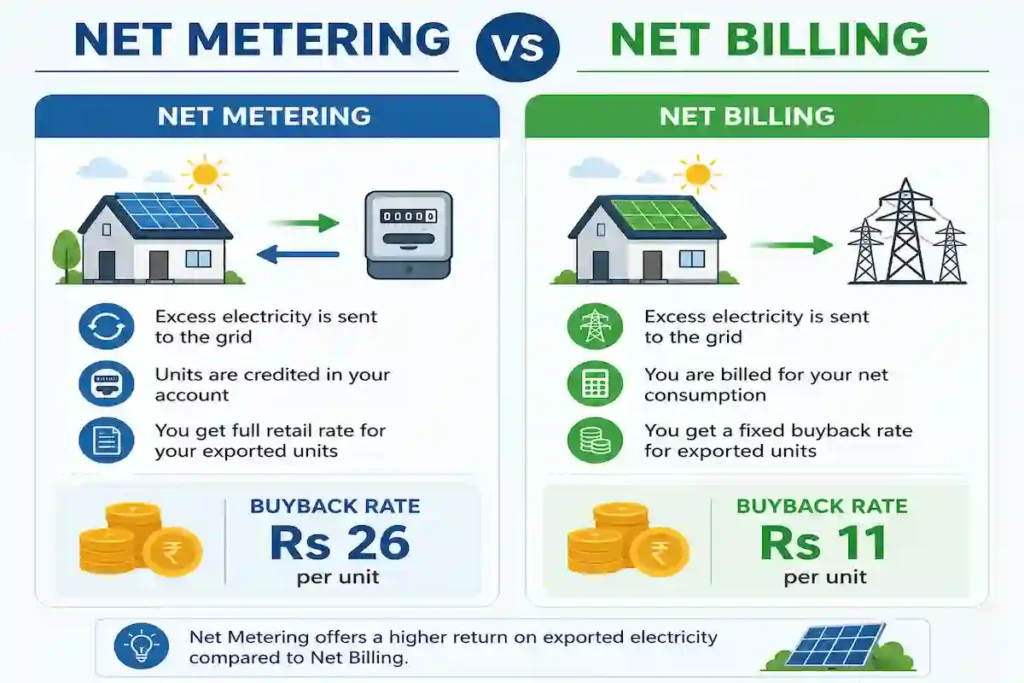
If you read the Prosumer Regulations in depth on the 9th of February 2026 by the energy regulator NEPRA, you’ll notice that these regulations have actually removed the possibility of using Net Metering as a solar customer and replaced it with “net billing”. In the previous net metering system, if you export 100 units into the grid and later on you use 100 units that are imported, then these units cancel each other without considering anything else.
Net billing completely severs this relationship. It is now such that the units you are putting into the grid and the units you get out of the grid have separate values, and it is the difference between the buying and selling price that creates the problem.
As per the new policy, you are selling to DISCO for only the national average energy purchase price. At that time, this was approximately 11 rupees. For selling your exported solar electricity. Meanwhile, you still have to buy your grid electricity at the same time from the consumer tariff that you were getting before, and that usually varies from Rs 37 to Rs 55 per unit for most residential consumers in cities like Karachi, Lahore, or Faisalabad, depending on the slab and DISCO of the person involved.
This is the major difference, and that one you have been selling back high-priced electricity at a very low cost and then re-buying it at retail price. It didn’t take the consumers long to react. The energy sector groups, solar companies’ associations, as well as just solar homeowners came together and protested so strongly against Prime Minister Shehbaz Sharif that it was the prime minister who personally asked the NEPRA and Department of Energy in the ministry to get their hands dirty and do an investigation within a very short time from the policy issuance.
In case you are still unsure about how the previous one-to-one tariff was being utilized by your electric provider, stepping back to recap it is a good idea. We have a detailed guide on net metering in Pakistan that shows you the whole procedure from the start through to the end, highlights DISCO-level variances, and explains how your billing cycles are calculated. Having this knowledge at hand is a great way to prepare yourself for the net billing concept.
If You Already Got A Net Metering Connection: Relax And Stay Safe
NEPRA came up with a revised edition of the NEPRA Prosumer Regulations 2026. That was the amendment that finally calmed most of the people. The main idea there was that the change would not affect the present contracts or agreements, and those existing net metering contracts would remain as they were.
If you installed your project before the new policy started, your old contract is valid, and you’ll be buying/exporting at an old buyback rate until it runs out as per your original agreement term. In most cases, it is agreed for a seven-year contract. So, in fact, those 2022/2023 installation homeowners are protected till about 2029/2030.
If You’re a New Applicant: The Math Has Changed
The terms will fully apply to everyone who applies for net metering after February 26th, 2026. In addition, the contracts will now be five instead of seven years long. The buyback price has dropped to around Rs 11 per unit, whereas earlier it was Rs 26 per unit. Meanwhile, the price you pay DISCO for your import hasn’t changed.
If you pull in electricity from the grid, you still have to pay full price for it. On practical grounds, the exporting of surplus power is no longer where your savings lie. Savings come from self-consumption.
So if you are thinking of getting a new system installed in 2026, the better approach would be to size it more or less to your actual daytime consumption only instead of planning to get the rest sold again and going big and the like. Operate your washing machine, geysers, and water pumps during peak sun hours.
Also, add a battery – not necessarily an expensive one, but any small one will do, – it will not only allow you to use your surplus on the day but also give approximately twice the value of selling to the grid. So, for most new installations, a solar plus battery system is becoming much more a practical and cost-effective choice rather than being a luxury item.
Is Solar Still Worth It in 2026?
Yes, honestly, but with a different kind of investment plan than was possible just two years ago. In a big city like Lahore, an appropriately scaled 5 kW combination power and storage system would cost you about Rs 550,000 to 650,000.
And with LESCO or K-Electric prices as they are, a family which mainly consumes what they generate during the day is still able to recoup their initial spend in four to five years.
Though, as you can imagine, when you have an export-oriented system which oversizes generating surplus power, it becomes financially very unfavorable very quickly because exporting power at the rate of Rs 11 per unit hardly recoups the cost involved in electricity generation.
The biggest losers currently are the ones who have been installing systems in November to December 2025, expecting maximum export income based purely on the old 1:1 rate.
If this is your situation and you are also new to the process, you must talk to your system installers whether retrofit a battery storage system is a possibility so that your overall strategy can change from selling off the surplus to storing it for later use.
Common Mistakes People Are Making Right Now
Many householders are abandoning all solar plans completely or selling the systems, which in most cases just represents a knee-jerk reaction. Others, on their part, are just too eager to update their existing systems without being aware of the legal implications of such an act that could make a person lose out on their original rate.
And some are still sizing up systems using the old method, going for a system large enough to export a substantial amount, even without recognizing that a significant portion of the previous income is now lost with the export. So, before signing off on the installation contract this year, be very careful, ask explicitly if their proposed price is based on net billing or net metering of the old version, as most of the marketing activities haven’t been able to catch up with that yet.
Final Notes
Net metering in Pakistan is still a matter of discussion, and honestly, considering the speed at which the government passed an order in February and then the prime minister stepped in just a few days later, it is likely still not a completely resolved issue.
At this moment, it is only definitely known that existing users can really protect themselves without changing their system’s sanctioned capacity and that, from the aspect of new applicants, they have to redesign their whole concept of how they will install and use a solar system.
Solar power remains a good financial investment at the beginning of 2026, but unlike at the end of 2023 year when the system focused on exporting power, it has now turned inwards; that is, it is mainly about using your energy supply.
Frequently Asked Questions (FAQs)
Has net metering been entirely stopped in Pakistan?
No. It has been replaced by net billing for new users, but the existing net metering agreements that were made before 2026, February 9 will continue to be in force under the original conditions until their expiration.
What is the current solar buyback rate under net billing?
Approximately Rs 11 per unit per the National Average Energy Purchase Price, while about Rs 26 per unit were being offered under the former net metering regime.
Will my existing net metering contract be terminated?
Your contract will not be terminated unless you are making changes to your system’s sanctioned capacity or output. Otherwise, your agreement remains for the original duration without any change.
Do I still have to put in solar if I have net metering?
If it is a solar system you would like for your home, a roof-mounted system, and you can only make use of the generated electricity at home (i.e., during the day hours) and not the surplus being exported, you may go for one, else maybe not. With the introduction of the new rules, it will be better to install a battery storage unit with your solar system for the energy generated during the day to be stored, and the same can be consumed at night.
Now, for how long are new net metering agreements made valid?
Five years, this time around, instead of the seven-year period that was formerly set.


