
Government Solar Subsidies in Pakistan: Are You Eligible?
In April 2026, a family member of mine who lives in Faisalabad tried getting approval for a solar subsidy from CM Punjab with a form submission that lasted three weeks. To her great disappointment, she found out that her family consumption level was too low for the solar panels to be considered for a “priority” category.
Whereas a family across the street with an average bill of 400 units managed to be approved in just 11 days! That’s one thing they just don’t tell you about solar subsidies. In particular in Pakistan, the solar subsidies are not just one single category, and they definitely don’t work all the same, and sometimes the reason you get knocked out of the process is almost the reverse.
If you came across the phrase “free solar panels” through either the news or the social media group conversation and are wondering whether you could ever qualify for it, or you have been contemplating if net metering is still worth the investment after the recent alterations in the rules, this article will be of great help to you.
What do people usually refer to when talking about “government solar subsidy”
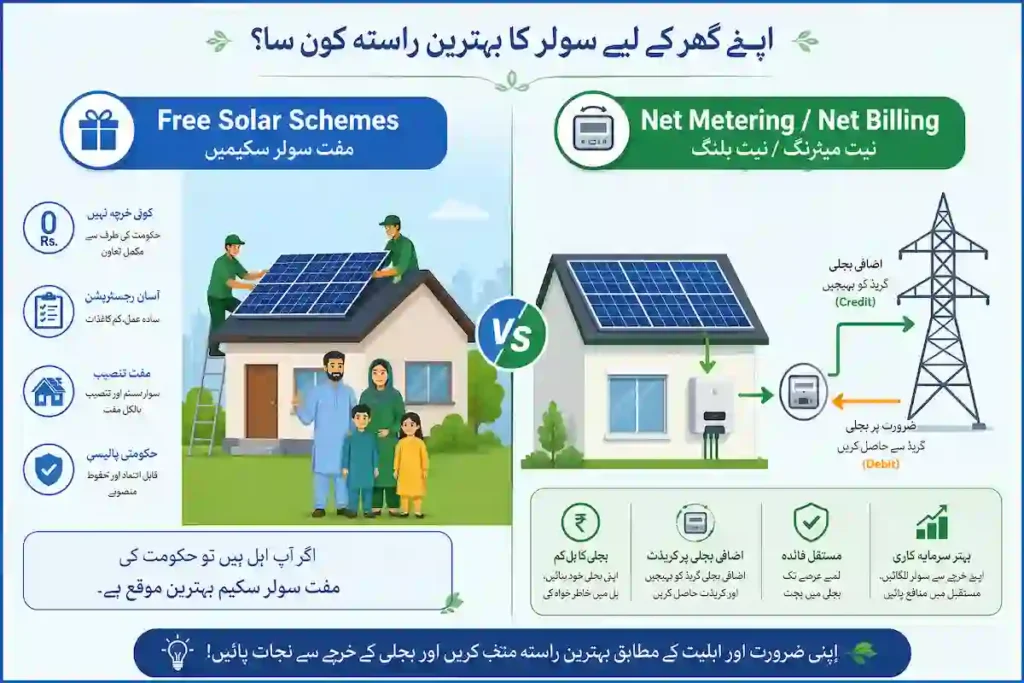
Well, actually, confusion often starts here. When people refer to “government Solar Subsidy,” they are usually just one of two completely separate government programs, which are the solar subsidy for low-income people, on one side, and net metering on the other. It is very easy to get confused and mix one with the other.
The first one is more of a social welfare-type program where a free or a subsidized solar system is provided only to the poor segment of the population, and it is mostly at the level of the province.
Punjab’s version under Chief Minister Maryam Nawaz is officially called Roshan Gharana Solar Program (but colloquially and on social media, people often also use the phrase CM Punjab Free Solar Scheme). This project targets those who are not financially able to go for solar on their own. That’s why it also includes income and consumption restrictions.
The second is called net metering, but from the February 2026 changes, it was restructured into net billing. It is an entirely different mechanism, not giving anyone a handout. It is a legal mechanism that enables any residential or commercial rooftop solar system owner (individuals, households, businesses, or even industrial companies) to sell the excess electricity through the Grid connection to the utility (i.e., the power company). If you have a small home or apartment and have the money to finance the purchase of a solar system, whether you are rich or poor, you get the same benefits.
Still, if you’re reading this as a resident of Lahore or Karachi and you are planning to buy your own solar power system at 5 kW or even 10 kW capacity, you have a major stake in the net metering rules since that’s the only subsidy that will change the return on investment on your system, not the free panels one. I’ll be explaining to you first the eligibility criteria of the free panels program and then the eligibility for the net metering program, but bear with me as they are so different from a qualifying perspective that I have to treat them as two different categories.
Eligibility for the Free/Subsidized Solar Schemes
The Roshan Gharana Program and its counterpart on the federal level, the PM Free Solar Panel Scheme, are not meant to be accessible for anyone who can put a roof over their head and can produce a CNIC. These programs target persons living in poverty, so the set-ups are such that the selection process can reflect that.
The requirements to be considered a potential recipient of this program are listed below before one proceeds with the filling of the required document:
- Household electricity consumption must be in a certain range, usually 300 units per month or less, as the government sees that as the main indicator for the question “Already having the money for a large system?”
- The applicant or a close member of the family must be the holder of the electricity bill and should provide a valid CNIC with one’s name or the name of a close family member who is the holder of the electricity bill, as the DISCO account of the applicant or their family member will be the basis of your application.
- Your house or property must be residential in nature since commercial, industrial, and rental units of different kinds are not eligible at all.
- And, the solar program is the only subsidy that the applicant can receive since these projects aim not to overlap.
- Among others, the lowest income group is often the one given a chance first.
That limit of 300 units is one of the reasons why my cousin’s application was rejected – because of having one extra fan and a mini/refrigerator added, her family’s electricity consumption had increased from 300 units to 340 units. So, the family was not in the queue for priority as the area gets around six to eight hours of load shedding per summer afternoon. If your case does comply with the requirements mentioned above, the actual process of submitting the application is done via the Internet:
You have to go through the website of your provincial government with your CNIC or a photocopy if you have one, together with your latest electricity bill. The website will ask you to type in your personal details, address information and rooftop details.
You will get a serial number so you know at all times where your application stands. The scheme is now underway: eligible families receive the complete equipment, like solar panels, inverters and sometimes a battery system at cost-free or at least very cheap installation. Separately, agricultural households are catered to by the Punjab Solar Tubewell Programme, which was expected to distribute around 8,000 free solar pumps to Kissan Card-holding farmers in 2026, and it is supposed to have been a solution for reducing expenses on diesel and electricity for irrigation.
Fair warning: welfare projects come in batches, government funds are limited, and there have been slow developments with even smaller funding in provinces other than Punjab. If you live in Balochistan, KP, or Sindh, go to your local department of energy website to know what the case is for your place, without relying on the Punjab rules.
Net Metering Eligibility and Why the Rules are Changing Before Your Eyes
Many people get surprised here because they think “solar subsidy” means the same net metering arrangement where every export unit was equal to every import unit. That way of things is no more.
On the 9th day of February 2026, NEPRA substituted the 2015 net metering system with its Prosumer Regulations under which the electricity selling price would be based on the market average – the so-called net billing system.
Before, a consumer who sent 100 units to the grid during the day and pulled 100 units at night paid nothing, as the system allowed a 1:1 exchange. With the new arrangement, the price at which your excess electricity is purchased by the grid will be the Average National Energy Purchase Price, which, for instance, is between Rs 8 and Rs 11 per unit for a new customer, much lower than the existing customers who were paying roughly Rs 25 to 27 per unit that they received from NEPRA.
In contrast, a household in Karachi is currently paying between Rs 55 and Rs 65 per unit for power taken from the grid. This huge price difference will be quite detrimental to the financial sense of installing larger systems for feeding power back to the grid.
Existing customers with a signed net metering agreement dated before February 9, 2026, have the advantage of sticking with the old payment rates until the contracts expire. After government pressure at the PM level, NEPRA put forward a revision of a document that said that existing agreements at the rate of supply will continue as long as they last, instead of being converted at once. Power Minister Awais Leghari also assured that about 5,165 pre-submission applications made before the February 8th deadline, representing the total capacity of some 250 megawatts, would still be handled under the earlier policy.
Those among you who are just starting in the mid-2026 phase are advised to remember these points about qualifications and charges:
- Firstly, you’re confined by your maximum allowable load, so it’s no longer feasible to install a 10 kW system for a 5 kW customer connection.
- You are supposed to find a registered NEPRA installer, which, with the installation of a bi-directional smart meter costing you Rs 18,000-28 000 will necessitate also installing an inverter with anti-islanding protection features.
- From April 2026, it will be a new kind of licensing fee that is about Rs 1,000 per kW. So, the paperwork costs of a 10 kWh system will increase by another Rs 10,000.
- Durability has been reduced for the contracts for power generation. They are now five years instead of seven as the previous one was.
- The number of approval days depends upon your DISCO and the preparation of your documents. It is expected to be the average of 30-90 days.
The changes do not mean you abandon solar altogether. Solar still can be a money-saving investment even when solar return comes mainly from using your own electricity in the daytime, i.e., not selling surplus electricity to the grid, which gives you less profit. Your system’s financial viability will still depend on a good design that matches your actual daily household requirements without overkill.
Common Mistakes People Make When Trying to Claim These Grants
The most significant mistake is trying to get into a free/subsidized welfare program when you actually use very high volumes of electricity, which then wastes a lot of time getting rejected. First, average your last 3 electricity bills.
Next, people are often mistaken about believing their previous net metering offer from a solar company was correct based on the old buyback rules from 2023 or 2024. When a salesperson is trying to convince you that your solar investment would take only a few years to make up because of high paybacks for each unit exported (say, Rs.25+ per unit) and you are a new applicant, directly ask them what regulation they are using to determine the price.
Many solar panel suppliers have not updated their sales presentation after February. The third major oversight is forgetting that commercial and rental property holders are completely barred from these welfare schemes, regardless of how low a renter’s income might be. This eligibility check is made on the type of property, not the income of the applicant!
Final Thoughts
In case you are a low-income family in Punjab only moderately consuming electricity, getting solar through the Roshan Gharana or CM Punjab route is truly worth the investment – having access to free hardware is an advantage you can’t miss, even considering the lengthy process.
If you are a householder with the intent to acquire your own solar setup, it is better to design the system around “how much you would use during the day” rather than trying to sell all the surplus power back to the grid. That makes the installation more economical.
Anyway, keep an eye on the dates provided and any document you’re given, since for solar policies in Pakistan, some changes could have rendered two agreements completely different even though they were made only a few months apart.
FAQs
Is it true that only people from Punjab are entitled to apply for the CM Punjab Free Solar Scheme?
No. It’s a state-level scheme only, so the residents of other provinces have to get their own provincial electricity departments’ information rather than take Punjab as a reference.
Does the word net metering have any meaning for Pakistan?
It is now being referred to as ‘net billing.’ All the former agreements signed on or before February 9, 2026, will continue till their expiry or cancellation under the former provisions, whereas the new customers will be offered the newly determined buyback rate under the solar policy.
Can you name the currently valid NEPRA buyback rate for new users?
The price that new users are getting for the electricity that they export back to the grid is approximately between Rs. 8 and Rs. 11 per unit from mid-2026 onward. The old system had been paying the solar users Rs.25 to 27 for every unit they were able to sell through their meter. That’s a massive difference.
Is it possible to use both the free solar program and net metering?
No, for one thing, the solar schemes explicitly mention that families who use solar power as a means of subsistence cannot be entitled to any other government aid that is related to solar power either.
Could I use the free solar program for my rented house or commercial shop?
No, the answer is that neither is eligible for such a scheme. It’s only for owner-occupied residences.


