LONGi vs Jinko: Which Panel Actually Deserves Your Roof in 2026?
Recently, a friend from Lahore, living in DHA Phase 6, sent me two quotations.
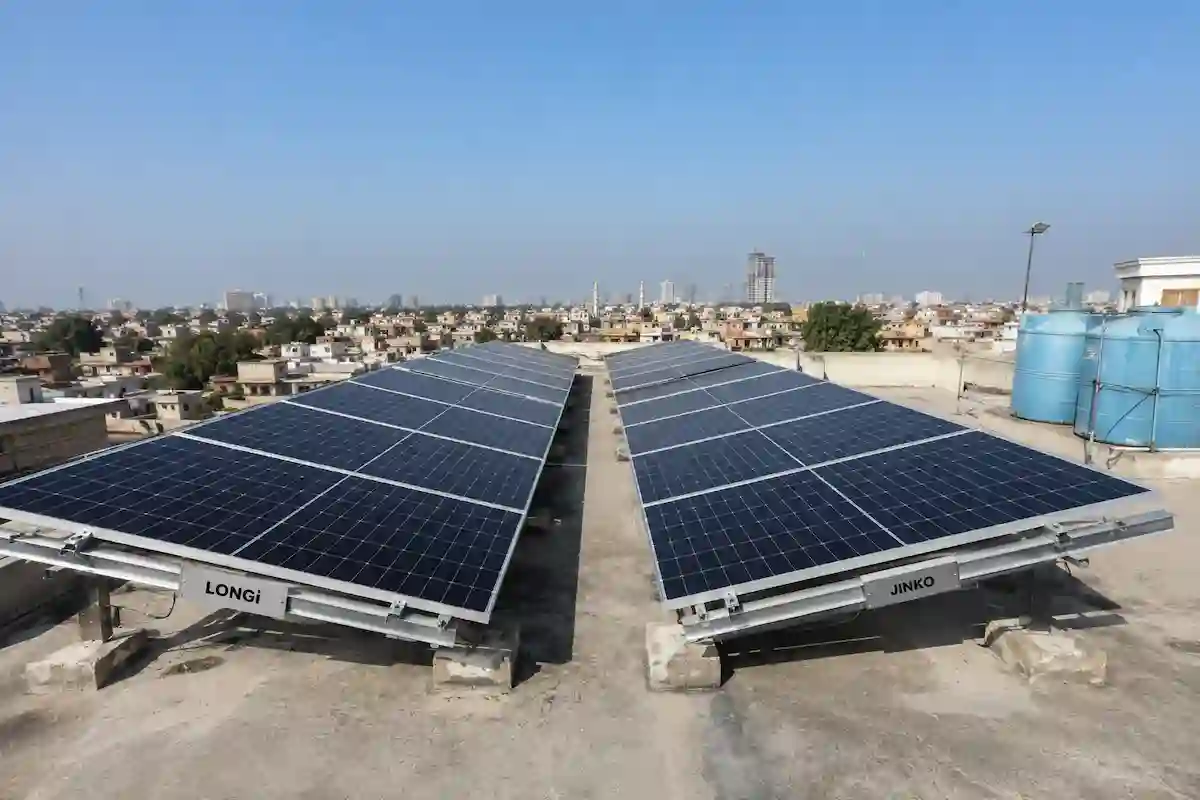
They were for an identical 10kW system, the same inverter, the same structure mounting, and the price almost matching each other. Only detail was that one quotation was for LONGi Hi-MO 6, and the other was for Jinko Tiger Neo panels. It was a Longi vs Jinko solar panels comparison.
He was quite perplexed about how to compare them, but I couldn’t decide, so after some research, I finally got to the bottom of it. If you’ve walked in Hall Road or seen solar dealer pages online, these names of the two big solar module producers, LONGi and Jinko, will be most familiar to you.
To be frank, the solar market of Pakistan has been quite dominated by them to a very large extent. They are both among top-tier manufacturers. Also, they provide financially safe investment and have already been installed on thousands of homes from Islamabad to Hyderabad. Differentiating which solar panel company one must go for is very difficult when both are good. What comes next are my observations.
Who Is LONGi?
LONGi is currently the main producer of monocrystalline silicon wafers worldwide. This point is often overlooked, but it really adds more value to the product. They do not only manufacture solar panels but also manage the complete supply chain from the raw material stage, including the ingot, wafer, cell, and module.
This is probably one reason why they can maintain quality even at such a high level of demand.
Who Is Jinko Solar?
Jinko Solar is known for its large-scale solar module manufacturing and speed to market. The most impressive thing about Jinko is probably not that they produce large quantities of solar modules or the speed with which they introduce new panel technologies for mass production, but in reality sometimes their rate of introducing new cell technologies is even quicker.
A few quarters ago, Jinko became the leader not only in the Asian market but also globally in solar power output. Both are public companies and are recognized by BloombergNEF as highly bankable.
Both have been regularly identified with the “Tier 1” label in solar sector rankings. We are still talking about differentiating not just by a manufacturer’s ability to provide quality products but also by a manufacturer’s ability to produce large quantities of these modules quickly, which is what really differentiates one from the other.
What Is Your Solar Module Worth to You?
Both these solar panel suppliers offer solar panels that could be considered to be of equal worth according to what aspects of them are being compared. Yet, from a practical viewpoint, a slight difference might be noticed for the type of usage, whether it’s being put up in Multan, Islamabad, Faisalabad, or Rawalpindi.
Here is a simple fact check of the “Tier 1” tag. Most salesmen use it simply as a quality assurance sign in Hall Road. But if you look into it in more detail, Tier 1, based on the BloombergNEF way, actually means whether the banks can support financing of the manufacturer’s projects rather than the aspect of the module, like the cell efficiency or how it is built.
You will find it very handy knowing this if you don’t want to be persuaded by the price tag of the product. Don’t worry if you are not going to do the research yourself, because we also have the complete catalog of top-tier solar panels from well-reputed brands with pre-vetting done in case you just want to take our opinion about them and save the time of going into a detailed investigation yourselves.
LONGi vs Jinko Solar Panels: Head-to-Head
| Feature | LONGi (Hi-MO 6) | Jinko (Tiger Neo) |
|---|---|---|
| Cell technology | N-type TOPCon | N-type TOPCon |
| Efficiency (580W) | 22.3–22.8% | 22.5–22.8% |
| Temperature coefficient | -0.28%/°C | -0.29%/°C |
| First-year degradation | Under 1% | Under 1% |
| Annual degradation (after yr 1) | ~0.4% | ~0.4% |
| 25-year output guarantee | ~87.4% | ~87.4% |
| Product warranty | 12–15 years | 12–15 years |
| Price per watt (mid-2026) | Rs 40–45 | Rs 40-45 |
| Local dealer network | More established | Growing fast |
| Warranty claim speed | Generally faster | Improving, city-dependent |
| Best for | Commercial/industrial | Tight budgets, residential |
If you’ve chosen other than LONGi and Jinko solar panels, you don’t have to feel short on information because we have a detailed solar panel brand comparison that explains how JA Solar, Canadian Solar, and other companies’ products differ from these two mainly for efficiency, pricing, and warranty support.
The Panels You’ll Actually Be Offered
Let’s talk about panels you probably will see or be offered. Closing the market in Pakistan at this time are the product ranges of two leading manufacturers.
LONGi Hi-MO 6 (and its more commercial-oriented version called Hi-MO 9). Jinko Tiger Neo. The manufacturers use almost similar technologies: N-type TOPCon cells, which have succeeded the older P-type ones (panels of P-type were very popular during 2022 and 2023).
Here’s what you would be ultimately getting. 580W LONGi Hi-MO 6 would normally have 22.3- 22.8% efficiency. The Jinko Tiger Neo’s 580W would be in the 22.5- 22.8% range.
We are talking here that the two figures are almost the same. A few tenths of a percent can change nothing on your payback period. The main difference is the temperature coefficient.
LONGi Hi-MO 6 has a temperature coefficient of about -0.28%/C, Jinko Tiger Neo at around -0.29%/C. If you imagine your rooftop surface in Multan is going to be 65-70C in June, that is a tiny difference which will be multiplied all through the summer months.
Besides this, there is ‘degradation’. You cannot rely only on what a dealer says; ask him to show you the datasheet. One thing these companies are promoting is that, in reality, they are having ‘less than 1 percent degradation in the first year’ and ‘roughly 0.4 percent every year after that’. Also, they have a policy of 25-year warranties which guarantee ‘around 87.4% of the output at year 25’.
If a technical datasheet with these details is not available to you, then that should be considered a problem instead of the technical aspect that needs formal treatment. Looking for the real latest figures rather than my personal recommendation? We have a LONGi solar panel prices and specs Pakistan page which is updated as we take in new product shipments.
Alternatively, you are also welcome to browse our stock of Jinko Tiger Neo on our website directly to compare wattage options. If you have any other questions, please do not hesitate to reach out!
What It Actually Costs You in Pakistan
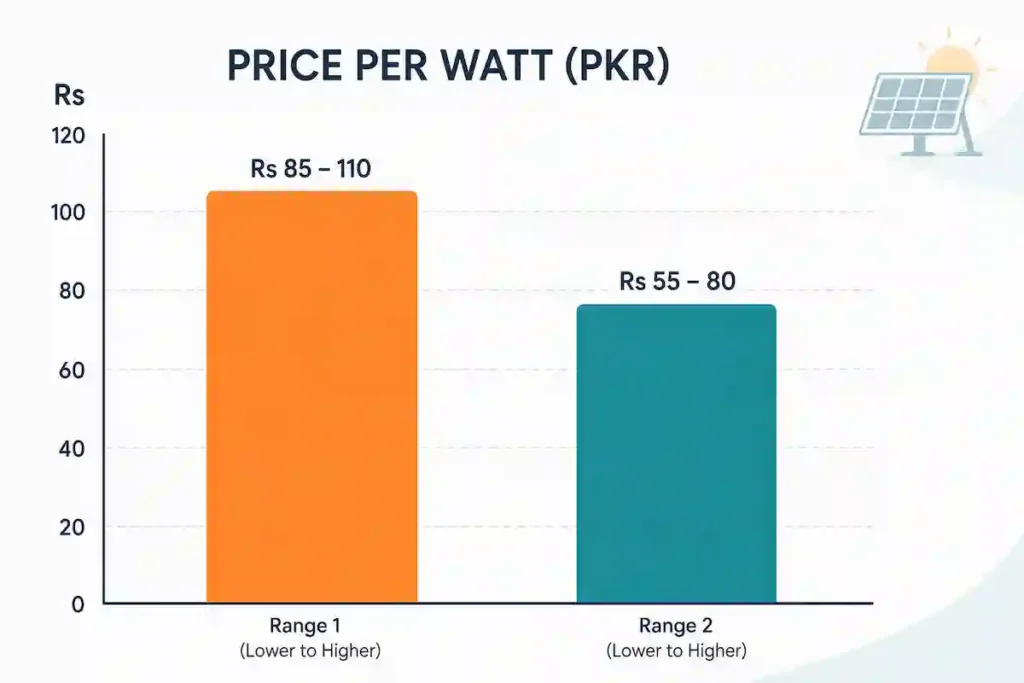
The price of a 580 W LONGi panel by mid-2026 at bulk import level is around Pakistani Rupee 41-44 per watt.
Jinko’s Tiger Neo stays mostly very close, with one or two rupees difference, maybe a touch less if the customs were just a new shipment.
This can swing the total cost of a standard 10kW household solar installation in Karachi or Lahore by Pakistani Rupee 15,000 to 25,000.
Benchmark to your budget – not the main criterion.
It’s availability and post-sales service.
To put it straight: LONGi is one of the earliest Chinese solar PV suppliers to come into Pakistan with long-running support structures. The reason is their well-established distribution channels. So, a local representative is quicker to reach than a manufacturer in China that doesn’t have any support structure here. Because of this, the turnaround time for warranty claims may be more in the case of other PV providers who have just entered Pakistan but have not yet built up a robust customer service infrastructure.
Jinko’s also been gaining ground. Their aggressive pricing has made them the go-to provider for installers working on roofs of the size of 5-marla or 10-marla with a limited budget.
Both companies are in the right. If you are located in one of the minor cities, with two hours’ drive to the nearest authorized dealer, it is advised to clarify with the seller how long the warranty process typically takes and mainly who will be involved if something goes wrong, etc.
I have known situations where both brands did just about everything correctly, and I have also known the opposite. The difference usually lies in the fact whether you have a warranty through a certain importer or an authorized dealer in Pakistan, not on the name of the panel brand itself.
Don’t know how many solar panels are needed by your roof? You’d better not start comparing costs yet.
Feed your solar consumption (the monthly units) into our solar load calculator first, and it’ll guide you to an accurate and optimized solar size, regardless of whichever brand they come from.
A Real World Example
You decide to set up a 7 kW grid-tied system in Islamabad, for instance.
Your WAPDA monthly bill is Rs 35,000. So you just wanted a way to have electricity but without paying for it.
Net metering is the game-changer, so if you do net metering, then a good relationship with IESCO is a must, not just a panel brand. That is all about your inverter and documents you submit for electricity.
But a minor half-percent efficiency advantage and a bit better temperature coefficient will, over 25 years, make for that extra bit of production.
Approximately a 3,000-4,000 unit difference, according to the system.
At today’s unit rates, that difference is considerable. It’s not the kind to haunt you through sleepless nights during loadshedding. But it’s quite real money.
Common Mistakes People Make When Deciding Between Them
Buyers become involved in the brand war, forgetting that the solar panel is just a component of the system.
There are quite a few cases I encountered where people bought premium LONGi panels and afterwards put them alongside an inexpensive, no-name inverter that throttles power output during the hot days. This not only wipes out the efficiency advantage they just shelled out for but is actually counterproductive.
I have also come across examples of electricians slipping in stocks of older P-type panels from either manufacturer.
Most importantly, they reckon on it. In reality, almost all customers never request serial numbers and, in turn, don’t check those serial numbers on the manufacturer’s verification page.
Because of this, three actions you should do if you are thinking about signing a document:
- Ask for the real panel model number, not just the name of the manufacturer as a category.
- Confirm whether it is N-type or P-type.
- Download the datasheet PDF and cross-check the panel serial number from the brand’s website.
LONGi as well as Jinko have the exact verification features that you can use on their websites, so you are sure you are getting the real panel.
Which Solar Panel Brand Would You Buy?
The major point to get solar installed is that for almost any residential solar rooftop installation in Pakistan, that is a 20-year project. A proper authentic panel will suit you from either brand.
Short on funds? Go for the best watt output in rupees. In this case, the Jinko Tiger Neo typically takes first place.
Laying out for bigger commercial or industrial solar farms and you know that even tiny differences in efficiency across hundreds of panels will affect you quite A lot? In that case, LONGi’s better temperature performance and a bit longer local operation background will be your main concern if your dealer has local warranty support at a high level.
Though, something I wouldn’t really do myself: let brand loyalty make a person disregard due diligence.
Get hold of the datasheet and verify the serial number. You should also ask for written warranty clarity that your panel brand is of lesser concern compared to your seller’s integrity.
Besides, keep in mind that one panel is the system’s second part only. So even good-quality panels will do a poor job, say if matched with a low-efficiency inverter or a type of inverter that’s a poor match. This is something to keep in mind!
Our hybrid solar inverters could be an option. Check if that choice isn’t final yet.
Or just avoid all analysis and research. Call us, explain to us the roof size and your monthly bill. The way we figure it out for you will give you a fair deal comparison with LONGi and Jinko that is perfectly suitable for your load.
FAQs
Is LONGi better than Jinko for hot climates like Multan or Sukkur?
In high heat, both brands will be good. LONGi’s slightly superior temperature coefficient at above 45C brings it a marginal lead over Jinko.
Which brand is cheaper in Pakistan right now?
Usually, Jinko’s Tiger Neo is available at a price of so much lower per watt than others. This will also vary depending on when you receive the product, as well as how the market is affected by importers’ stock levels.
Do both brands offer 25-year warranties?
Definitely. Both have 12-15-year product warranty terms. It has 25 year linear performance warranties for the N-type solar panels.
Can I mix LONGi and Jinko panels on the same roof?
It is technically possible if voltage and current specification values are the same for both types of panels. Most technicians don’t recommend doing so – because it is more hassle for your claims, and you’ll probably get slightly less efficiency from mismatched panels.
How do I know if my panels are genuine?
Using the serial number printed on the panel’s back label, look it up on the manufacturer’s official verification portal. Always ask to see the original datasheet before making a purchase decision.