
How Much Does a Complete Solar System Cost in Pakistan? (2026 Breakdown)
Last week, a customer from Faisalabad told me that two solar installers gave him solar system cost in Pakistan with a difference of Rs 80,000 for the same 5kW system. Here’s what people mostly don’t know about the pricing of solar in Pakistan.
The short answer? Maybe both prices were “right.” The pricing of solar in this country is really puzzling. The installers are aware that most of the buyers do not have a solid structure with which to compare them. So it’s quite easy for them to increase the prices, silently change the parts, or provide quotes for different configurations without your knowledge.
I have been connected to this industry for a while and I have witnessed these types of conversations. Someone excited about solar, after getting two or three quotations, ends up choosing the one in the middle just hoping it to be the best. That is a guess not a strategy. That is a gamble.
So let’s start first by breaking down what a full solar energy system would cost in 2026, what you are paying for, and then we will discuss how to determine if the quote you have received is reasonable or completely overpriced.
3kW Solar System Cost in Pakistan (The Starter Setup)
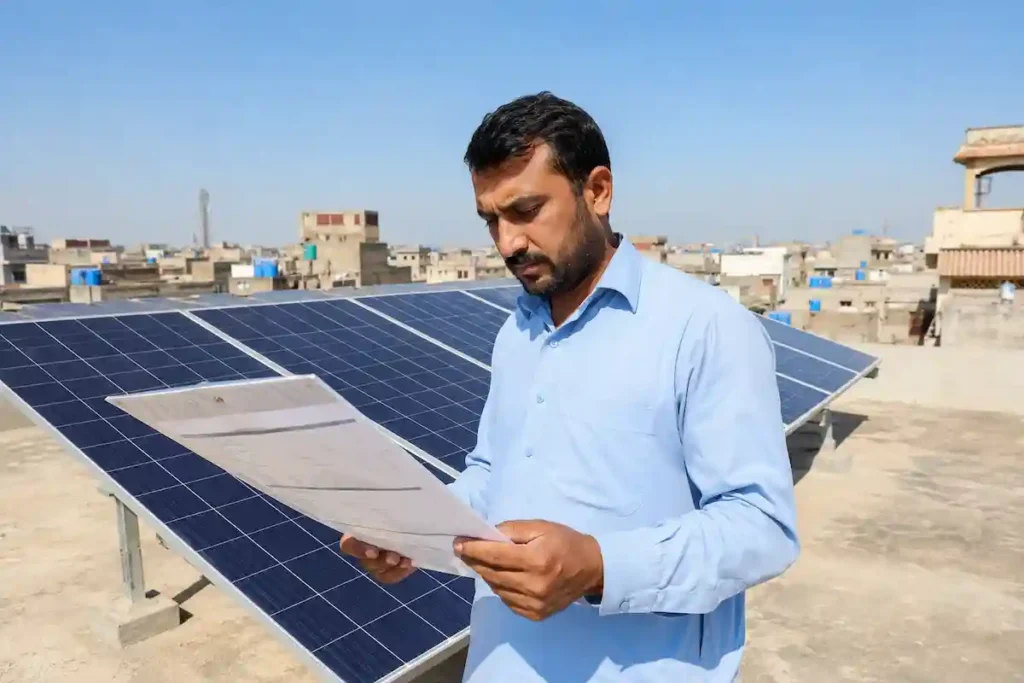
It is a suitable set-up for a house that contains a couple of fans, LED lights, a small fridge, and maybe a TV. If you happen to be living in 2-3 marla house or doing a small-scale business, you should consider this starting point.
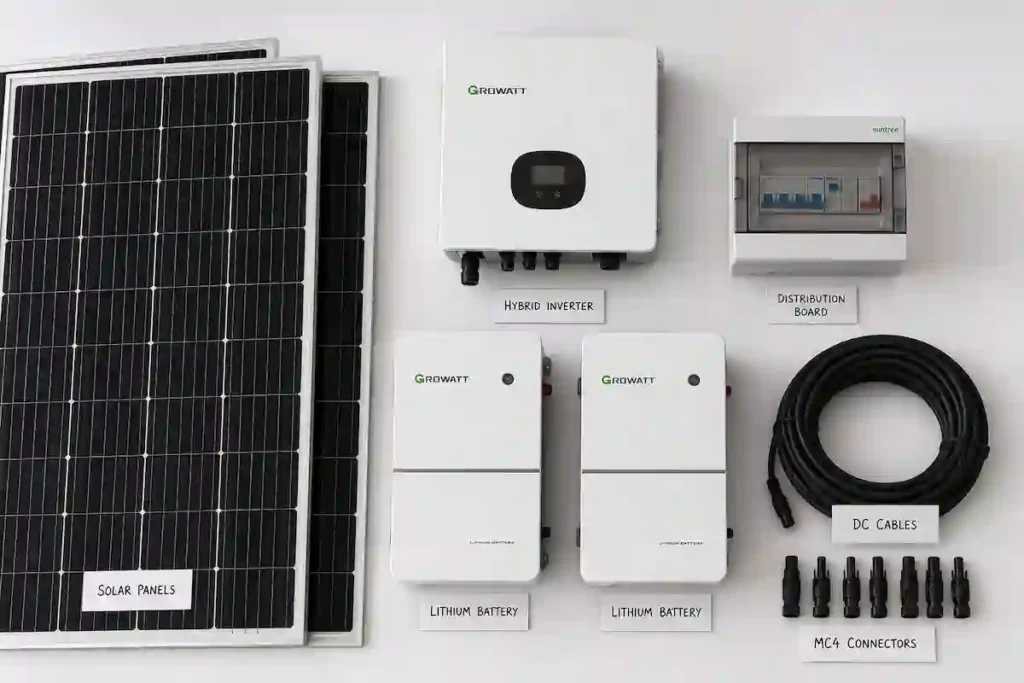
What’s included in a complete 3kW system:
| Component | Estimated Cost (2026) |
|---|---|
| Solar Panels (6-8 x 400W, Tier-1) | Rs 90,000 – 110,000 |
| Inverter (3kW hybrid) | Rs 65,000 – 90,000 |
| Battery (optional, 1x 200Ah lithium) | Rs 90,000 – 130,000 |
| Mounting Structure | Rs 15,000 – 20,000 |
| Cables, MC4, DB | Rs 10,000 – 15,000 |
| Installation Labour | Rs 15,000 – 25,000 |
| Total (without battery) | Rs 195,000 – 260,000 |
| Total (with battery) | Rs 285,000 – 390,000 |
Depending on the utility company, a net metering application fee (DISCO) can be an additional Rs 15,000-25,000.
Your solar system will generate monthly around 360-420 units if you get 4.5 peak sun hours. That usually supports a monthly energy bill between Rs 4,000 and 7,000.
The Growatt 3. 5kW Single Phase Hybrid Inverter currently stands as one of the best options for a 3kW system in Pakistan. It offers dependable warranty support, is NEPRA-compliant, and matches the load range perfectly. In case you want to go a bit beyond 3kW, the Knox Krypton Eco 4kW would be an equally great choice.
5kW Solar System Price (The Sweet Spot for Most Homes)
Various sources agree that 5kW systems are the ones most middle-class families in Lahore, Karachi, and Islamabad settle for. Actually, with 5kW you can run:
- 1.5-ton AC (introducing only one load at a time)
- 1 fridge
- 1 Washing machine
- Lights
- Fans, and so on
A typical house of 4-5 marla can function well using this system.
In fact, this is also the point where lots of pricing confusions occur because there are so many ways to construct a 5kW system.
Complete 5kW system breakdown
| Component | Estimated Cost (2026) |
|---|---|
| Solar Panels (10-12 x 450-500W, Tier-1) | Rs 165,000 – 210,000 |
| Inverter (5kW hybrid, Solis/Growatt/Deye) | Rs 95,000 – 140,000 |
| Battery (2x 200Ah lithium, optional) | Rs 180,000 – 280,000 |
| Mounting Structure (elevated) | Rs 25,000 – 35,000 |
| Wiring, protection gear, fuses | Rs 18,000 – 25,000 |
| Installation Labour | Rs 20,000 – 35,000 |
| Total (without battery) | Rs 323,000 – 445,000 |
| Total (with battery) | Rs 503,000 – 725,000 |
The net metering fee can be Rs 20,000-30,000.
This system can generate monthly about 600-720 units. By these days (LESCO Tier 3-4 pricing around Rs 45-60/unit), this is valuing Rs 27,000-43,000. This worth of electricity is saved every month.
Referring to our Faisalabad customer, his price difference was Rs 80,000 because one dealer gave a quote for a Solis hybrid inverter while the other one offered a no-name Chinese brand. Or one had batteries involved while the other did not. Both stated “5kW system.” At the same time, both of them did not lie, in a technical way. But plainly without knowing what to ask it is almost impossible to make sense from the two talking about the same thing.
Wondering if 5kW is actually the correct sizing for your household? Before deciding on any system, why not try our Solar Load Calculator? Just enter your household appliances and it will generate a suitable system size recommendation based on your real data. It hardly takes two minutes and could prevent you from making a mistake of significant over-purchase or under-purchase.
For the solar panels in a 5kW setup, we’d generally advise the Jinko Tiger Neo 580W N-Type bifacial or the Canadian Solar TopCon 585W these are two of the most heat-resistant to Pakistani climatic conditions and their manufacturers provide excellent warranty. You may check out our entire solar panels range for wattage and price comparison.
10kW Solar System Rate (For Bigger Homes or Small Businesses)
A 10kW system is nothing to joke about. You might be thinking about a big house (10+ marla), a small business, a clinic, or a restaurant setting. Several ACs, large appliances, and high daytime load.
Complete 10kW system breakdown
| Component | Estimated Cost (2026) |
|---|---|
| Solar Panels (20–22 x 500W, Tier-1) | Rs 320,000 – 400,000 |
| Inverter (10kW three-phase hybrid) | Rs 200,000 – 300,000 |
| Battery Bank (4x 200Ah lithium, optional) | Rs 380,000 – 560,000 |
| Heavy-duty mounting structure | Rs 50,000 – 75,000 |
| DC/AC wiring, protection, earthing | Rs 35,000 – 50,000 |
| Installation (2–3 day job) | Rs 40,000 – 60,000 |
| Total (without battery) | Rs 645,000 – 885,000 |
| Total (with battery) | Rs 1,025,000 – 1,445,000 |
Net metering fee at this scale: Rs 30,000-50,000.
Monthly generation: 1,200-1,500 units. At commercial tariff rates, you will probably elect Rs 70,000-100,000+ per month based on how you use energy and your bill level.
10000 watt is quite a large system, it’s ideal to go with the most high-efficiency panels available fewer panels per kilowatt means less space on your roof and lower costs for mounting. Our number one choice for big systems is the Canadian Solar TopCon 610W bifacial double-glass panel the double-glass design can resist Pakistan’s heat and dust rounds pretty well. When looking at a 10kW or bigger system, it would be prudent to contact us directly for a thorough load analysis and site-specific quote instead of relying on standard estimates.
First, Why Prices Vary So Much
Panel brand and tier
There is a huge difference between a Tier-1 panel (Jinko, Longi, and Canadian Solar) and a Chinese panel with a sticker. The only difference is, first one is involved in performance at least after 8 years of the deal and the second ones are hardly involved in performance after first year of the deal.
Should you wish to check the price of Tier-1 panels even before the conversation with an installer, feel free to explore the panels we have in store. We offer Jinko N-Type bifacial panels, Canadian Solar TopCon panels, and Longi panels with prices updated daily. Understanding the going rate for panels before you get a quote is like going to a gunfight with a gun when everyone else has a knife.
Inverter type
String inverters only would be cheaper if you want the least expensive option. Hybrid inverters would allow you to add batteries in the future but are costly. Some quotations don’t even specify it. They just say “inverter inlcuded.”
Under the existing load-shedding situation in Pakistan, a hybrid inverter is typically the more reasonable purchase. If you don’t want batteries now, hybrid inverter still lets you add them later. To get a sense of our hybrid solar inverter brands and prices, you can first look at the ones that we have available before you begin to compare offers.
Battery or no battery
This can single-handedly add to Rs 300,000-700,000 to a quote. Some solar installers quote with batteries to look complete while others quote without batteries. To compare these two is like comparing a car price with and without an engine. Fine. Then here’re the real figures.
ROI and Payback Period (The Real Math)
People always ask “when will I break even?” Here’s how to actually calculate it.
Example: 5kW system, no battery, cost Rs 380,000
- Monthly units generated: ~650 units
- Average rate saved (Tier 3 LESCO 2026): ~Rs 50/unit
- Monthly savings: Rs 32,500
- Annual savings: Rs 390,000
- Payback period: roughly 11-12 months
Thinking about adding batteries from the very first day? Then seeing the actual battery prices helps a lot since working on estimates is quite vague. We carry the AGS SP Tall 2000 Tubular Battery (180Ah) and the AGS DC-110 75Ah Tubular Battery both are from AGS which is among the most extensively serviced battery brands in Pakistan. Check out the complete solar batteries collection to find out the capacities and prices for your load.
Yes, you read that right. For an on-grid net-metered system without batteries, payback can be under a year if your bills are high enough.
Plus, with batteries, here’s the story:
- Adding Rs 250,000 for 2x lithium battery
- Total price: Rs 630,000
- Month-to-month saving: Rs 32,500
- Payback: approx 19-20 months
If you live in an area where there is a lot of power-outages and the alternative is a petrol-generator that burns a daily amount of Rs 400-500. Then the battery pays for itself purely via the fuel saving, besides the electricity saving.
In a way, solar panels after the payback period are free electricity generation for 20-25 years. This is what we expect to highlight.
Net Metering (Don’t Skip This Step)
Net metering allows you to supply the extra electricity back to the grid. When your solar panels generate more electricity than your household needs during the day, the extra electricity backs up your meter (or you get credits in your account). Ultimately, your bill is only for the electricity you have actually consumed.
The sequence:
- Make application to your local energy distribution company (e.g. LESCO, FESCO, HESCO, etc.)
- They check and approve your plan
- A two-way meter is set up for you (currently the whole process can take between 4 and 10 weeks it is very slow but definitely worth it)
- Now you are gaining credits
NEPRA (National Electric Power Regulatory Authority) is the governing body that officially sets the net metering rules, buyback rates, and the application process at the level of DISCOs. If you want to keep up with any changes in the tariffs that impact your payback calculations, consider bookmarking their website. In the last two years, the rates changed more than once and there will be changes again.
The charge is generally Rs 15,000-50,000 based on system size and the DISCO that serves your area. A few solar system dealers include this in their costs. The majority don’t. So make sure you ask.
Not having net metering means that you are losing money every clear day.
Common Mistakes People Make
1. Buying solely based on price
Usually the cheapest offer means cheap panels, an unknown inverter, or poor installation. You will probably realize it in three years when the output is less and the support under warranty is not available.
2. Not checking the brand of the inverter
Among the well-known brands that are available here are Growatt Solis Deye, and Huawei Solar. If the salesperson is unable to tell you the model number of the inverter, then it should be a warning signal.
3. Not doing the site survey
The angle of your roof, shadow cast on it by a boundary wall, or water tank, the length of your cable run all these have an impact on your system’s output. A proper installer should visit and inspect before giving an estimate. An incompetent one will just get your square footage through WhatsApp.
4. Disregarding the warranty
Tier-1 panels generally have 25-year performance warranties. Inverters typically have 5-year warranties (some brands provide 10 years). Ensure you obtain these from the local distributor, not just the installer, and in writing.
5. Up-sizing without load analysis
Sometimes an installer offers 10kW to a household which only needs 5kW. They get more panels, and more commission at the same time! Request them to produce a load calculation.
Components of a Fair Quote
When you receive a quotation, it should itemize this:
- Panel brand, wattage, and quantity
- Inverter brand and model number
- Battery brand, capacity, and chemistry (lithium vs. AGM)
- Mounting type
- Cable specs and protection equipment
- Labour cost (separately listed)
- Net metering application included or not
- Warranty terms
If a quote simply read “5kW solar system for Rs 420,000, ” that wouldn’t be a quote at all. That’d just be a figure on a WhatsApp message.
The Bottom Line
Solar power in Pakistan by 2026 is genuinely among the top financial moves most residential property owners can make. Electric power prices are soaring, sunlight is bountiful, and the times for recovering investments are shorter than ever.
But, the market is filled with uneven prices and quality. Learning what’s really being sold is the only way to save yourself.
Request detailed quotes. Compare identical parts. Inquire about brands. Check warranties. And if you get two quotes with a difference of Rs 80,000, ask both the installers for a precise breakdown of that difference. The one who brings you with a clear, detailed explanation is more than likely the person to rely on.
Are you done with research and looking at actual prices now? Then you can check out all the items we have in stock including panels, inverters, batteries, and all at real prices. Alternatively, just provide us with your load details and we will come up with the configuration that fits you best. If you are still unsure about the size of a system you will need, the Solar Load Calculator is a good starting point it will even take you less time than making a cup of tea.
Prices are based on market levels during mid-2026. Prices of components are susceptible to changes in USD/PKR exchange rates. Always request a new and updated quote before making a final decision.
