

Is a Solar Still Worth It in Pakistan in 2026? A Data-Backed Answer
Last month, my cousin who lives in Gulberg managed to get a 10-kilowatt hybrid electric system before it was too late for the net metering scheme because of the sudden announcement from the NEPR. He didn’t lose money and now gets electricity at a good rate from his home setup. The neighbor who lives just nearby, whose application was submitted in March, has gotten a bad end on a deal.
The buyback rate he gets is almost half of what my cousin paid per unit through the old system. Both of them are living in the same city, sharing a common rooftop and getting an equal amount of sunlight as well.
This math is really different just because a few changes in regulations of Solar Energy sector, and if your concern is whether or not getting solar power is a feasible idea for your place, then the honest reply is that it will depend solely on the time you submit your application, besides other technical factors, and not the general aspect of whether solar power is going to work or not in this region.
So, let’s see the details in actual numbers, as it’s the one factor that’s going to decide your case here.
The net metering rug-pull, explained simply
In the past, about eight years or more, the net metering scheme of Pakistan worked upon the idea of netting the electricity produced with the consumed electricity, i.e., 1 unit for the export of 1 unit.
During the day when you are away, the power export is around 100 units. Then in the evening when you return and run your fridge and fans, you get the same amount, i.e., 100 units of electricity back imported, and your bill goes down to zero.
This policy made large systems really very effective since any surplus electricity generated could even be sold on at the full price. That all came to a halt on February 09, 2026, when NEPRA changed it from a straightforward 1:1 system. They restructured everything as per NEPRA (Prosumer) Regulations, 2026. Thereby making small and rooftop solar eligible for a “net billing” system, repealing the decades-old system of net metering that had been in existence.
From a practical point of view, net billing means that you will still be getting a payment for the amount of electricity that you generate and send back to the grid, but at a very small fraction of the rate you had before, and not the case that the total amount of imported power was directly offset.
If you’re still not clear about how the previous system operated compared to what net billing actually changes step by step, you can find our full analysis about it in the guide “net metering for Pakistan“.
The guide includes the DISCO application procedure, new prosumer regulations, as well as what “grandfathering” actually refers to in your contract.
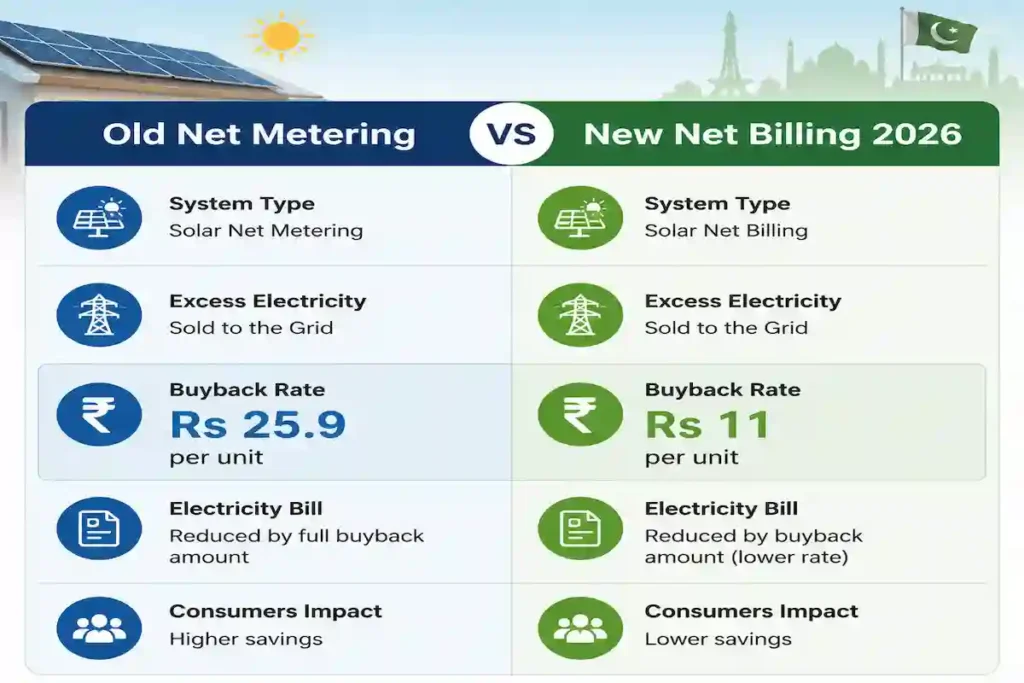
Here’s a simplified version of what was altered. With the new policy, the export price has dropped to approximately Rs 11 per unit, while the import price has remained at the standard retail rate, which is about Rs 55 -65 per unit.
That is a very high difference of about Rs 42, and so it is going to have a dramatic change on how people would size their solar systems. Because, under the previous rules, if you had a 15kW system only for a 10 kW household need, then you were going to make money from extra power sales.
Though now with net billing, that same oversized solar system will bring you approximately only one-fifth of what it costs to get equivalent electricity back at night with the energy you pay. Bigger does not always mean Better. Smarter is the better option.
If you have got yourself signed a contract before the said date of 09th February, then you can rest easy – as the draft amendment of NEPRA, the consumers with valid net metering agreements as of February 9, 2026 are allowed to remain on their old tariff schemes up the expiration of their respective agreements, while it has also been mentioned that approximately 5,165 of these applications representing a total of around 250 MW of the capacity were also given a sort of grandfathering under the previous policy as they had been in the queue for submission until the 08th of February. Everyone submitting their applications after the 09th of February will be under a different set of rules altogether.
Cost for panels and installation at this moment
Don’t pay attention to misleading solar panels’ comments about the solar being very costly or a cheap idea that you may notice in FB groups. This is a July 2026 price estimate based on the present level of installers’ rates.
The Tier-1 585W panels, think of it as Jinko Tiger Neo, Trina Vertex N, N-type ones that are the actual performers in Lahore summer heat, are priced at roughly 23,000 to 27,000 PKR each in July 2026.
A fully integrated system like the 5kW on-grid setup would cost about 5.5 to 7 lakh PKR with panels, inverter, mounting, wiring, protection, and net-metering filing.
Would you like to have your battery not rely on load-shedding anymore or the recent low buyback rate at NEPRA?
A 5kW hybrid system with a 10 kWh lithium battery will cost close to 9.5 to 12.5 lakh PKR. Moving to a 10kW will see you paying approximately 10 to 13 lakh PKR for an on-grid system only, or 16 to 21 lakh PKR for a hybrid with a 15kWh battery.
That’s quite a spread, and besides, of course, brand preference isn’t the only reason. P-panel types are cheaper but get degraded more quickly from heat. So while you are spending more money upfront on an N-panel type, after having it, you won’t be too disappointed since it will maintain its output well until 25 years later.
The cost of panels and installation is only an estimate and does change frequently. A static number in the text soon becomes an outdated piece of information.
Refer to our article “solar system for Pakistan cost” if you’d like a thorough breakdown of the prices for different system capacities – 3kW through 20kW – this article also explains the fluctuation of the dollar as well as import duty’s influence in the variation of installer rates.
It just might make the difference when you have a Faisalabad, Multan, or Multan flat roof during hot months like June. If the price for the “5kW system ” you are quoted is as low as Rs 400,000 by a vendor, then go ahead and ask whether or not the panels actually will be that size, and it will also help knowing whether or not it is the P or the N type. It has turned out that quite a big part of it, which makes the cheap deal and the fair one, are the areas where installers tend to take shortcuts.
There is an additional cost factor most people tend to neglect. As of April 2026, NEPRA set forth a license fee of Rs 1,000 per kW, which means that in case you are going to install a 10kW system, the net metering permit will cost you an extra Rs 10,000. Of course, as a fee, a small amount compared to the total. Still, this is one more item that, in most cases, installers have “forgotten” until the demand notice comes.
So does the payback math still work?
Self-consumption is becoming the whole strategy here. Your LESCO bill is not some single number. It is made up of slabs, and the unit prices in 2026 will vary from about Rs 3.95 per unit for the protected lifeline consumers up to Rs 47.69 for heavy non-protected users.
If your household consumes over 600 units a month by running two inverter air conditioners, a water pump, and a fridge, then you’re paying a premium for most of that consumption, which is precisely the electricity solar can replace directly right away and at nil marginal cost whenever there’s sunshine.
This is basically the main point at play here. Every kilowatt-hour you use directly from the solar panels gives you a saving of Rs 22, 27, but the kilowatt-hour you export earns you merely Rs 11, 13, as net billing.
Buyback rates and contract conditions are still to be completed via public consulting although these numbers are based on the NEPRA Prosumer Regulations 2026 already announced one after the other.
It would be better to check NEPRA’s official tariff notifications yourselves to get the latest and most correct tariff determinations rather than relying on second-hand figures.
So, for those who are looking to set up a system for home application today, the wise thing is not to size for a maximum export but to size for one’s actual daytime load first running the heavy appliances like AC heater washing machine, water pump etc. in the daytime only and if one can afford it, to get a small battery so that evening usage will come from solar battery as per the grid.
Taking the example of a 10 marla home in Lahore where the electric bill is about 800 units and most of the units consumed are from the non-protected slab, a well-sized 5 kW on-grid system paired with disciplined appliance scheduling is still landing the installer and his client in the 2.5 to 3 year payback range for the home, which is cutting costs by Rs 25,000 to 30,000 per month.
That is an accurate, achievable figure for 2026, not the 7-year horror story which some people are now spreading just because they are contrasting 2026 net billing against 2023 net metering economics, and that isn’t a fair comparison anymore, actually.
You shouldn’t go ahead and do this if you are a light user who has already been paying a protected tariff rate of less than 200 units a month. Then the mathematics quickly gets tight, that is, if you aren’t spending enough on electricity for it to make sense. Also, the export earnings under a net billing model just can’t save you the way they did after you have paid for the upfront cost.
Common mistakes people are still making
The big one that I regularly get on the WhatsApp groups is people who are referencing 2023 or 2024 payback times to try and sell 2026 systems. A person who assures you a guaranteed 3.5-year payback without checking first on your slab consumption or whether you are applying before or after the cut-off for net billing, leave immediately. They are either ignorant or simply praying that you won’t question.
Secondly, people still make the mistake of oversizing just to generate more sales by export income, whereas at the old rate, that income is no longer available. If your service provider is recommending 15 kW on a house that is only consuming 400 units a month, then you may ask why? As per the net billing guidelines, that surplus will give you a fraction of what you had before.
Thirdly, people still think saving money upfront by buying B-grade panels is a good move when actually, the real story is that these kinds of panels, which cost only Rs 18-28 per watt, not only lack the necessary certification and degrade faster, but, and that is the major reason, they cannot be registered for the net billing programme at your DISCO anyway. That “cheaper” panel might actually mean that you are locked out of the programme without any possibility of being rescued.
Final word
Around the mid-2020s, residential solar photovoltaic (PV) generation in Pakistan lost its charm due to net metering, where you were being paid full retail price for every exported unit. Though it has not vanished.
A new calculation is involved. For the mid-to-heavy electricity consumption home user, by aligning the solar system size with actual daytime consumption, selecting Tier-1 N-type modules, and seeing a battery backup system as a major consideration rather than a luxury add-on, a return on investment (ROI) of around two to three years is still very realistic.
The ones being hurt at the moment are those who solarized with 2023 conditions and are now facing 2026 electricity bills.
Frequently Asked Questions
Will the net metering facility continue to be available in Pakistan in 2026?
The answer is no for new solar panel applicants. From 9th February 2026 onwards, new solar installations are under the net billing regime with a lower buyback rate.
Should you have had a signed document before that day, your old agreement terms still operate until the expiration date.
What is the solar buyback rate available today?
The net billing regime for fresh solar panel applicants is Rs 11/kWh, approximately, and if the customer is a net metering one who was given a contract before and is now enjoying lower rates of the new regime, but he will still be paid near Rs 25.9/kWh until the expiration of his/her contract.
What is the cost of a 5kW solar system here at present?
Get around Rs 5.5 to 10 lakh (or so) for a utility-connected installation (i.e. a system without backup), while if you are the owner of an off-grid (i.e. a system with backup), a combination with a lithium battery will raise the total cost from Rs 9.5 lakh to 12.5 lakh, the total range depending upon the brand of modules and the choice of inverter.
Why would you still go for a solar installation in Pakistan, 2026?
If it was already decided by you that you are on an unprotected tariff and with a high rate of consumption, then the answer is, of course, the payback is within a 2.5- to 3-year period, and such a period is quite feasible with only a part of the solar electricity generated exported to the grid. But there is a weak argument if it is a light user who is already on the protective tariff.


