

Solar Panel Price Trends in Pakistan This Month
The only thing my cousin in Rawalpindi has been asking me this past year, one day after another, is, “Bhai, should I buy now or wait?” My cousin intends to install a 5kW system for his house in the Committee Chowk neighborhood, and just the other day he contacted a solar dealer. The quote that he received was different from his previous one.
Better understanding the market will help you stay one step ahead in these cases, and here is all the info that you get now from July 2026.
Prices per watt currently
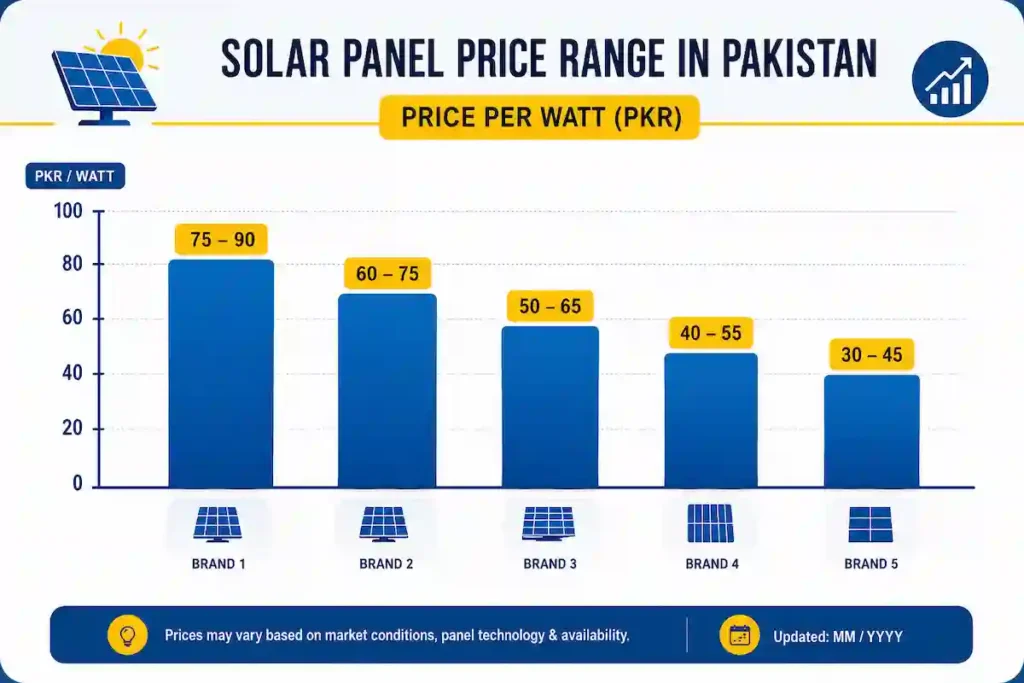
A-tier 1 panels are trading anywhere between Rupees 27 and 48 per watt this month, and this range is just so wide that without a clue, one might end up in confusion of his/her own.
In Lahore, Karachi, and Islamabad, A-grade panels are the normal market offering for Rs. 28 – 33. When it comes to premium N-Type panels offered by Jinko, LONGi, Canadian Solar, and JA Solar, per watt, one goes anywhere from Rs.42 to 48, with some of the high-efficiency HiMO or Tiger Neo models coming in with a price range of a few cents more.
The budget ones, Astro Energy and RENA Solar, were available in A-grade panels for about Rs 26.50-29, and the dealers along Rawalpindi’s Bank Road Market have started pushing them as this month’s “value” brand.
Let me take, for example, a 585-watt Tier-1 panel. That is the typical residential size installers are working with in the market these days, and each of such modules costs you roughly between Rs 23,000 and Rs 27,000. A Jinko Tiger Neo is among the highest priced, while a Trina Vertex N of the same wattage would generally be found closer to the bottom of that price range.
Why the price moved (or didn’t) this month
Solar manufacturers price their panels in USD at the factory gate in China, so even a slight change in the exchange rate can have an immediate effect on customers’ invoices. The dollar has been fairly stable at 278- 282 rupees in July, mainly why panel prices haven’t skyrocketed like they did when the dollar increased from 180 to 300, and panel rates doubled.
In fact, compared with the Tier-1 N-Type prices two months ago, this month’s prices are lower by just about Rs 2-4 per watt. That’s not the dollar; it’s competition. More supplies, more dealers, undercutting, and the global polysilicon prices (the main raw material going into PV cells) have come to a plateau after a big drop between 2024-25.
On the purchase of 10 modules, this difference is going to work in your favor by Rs 20,000 – 40,000, which is quite a number. Besides, since the customs duty of imported solar panels has already gone to 0%, there is still much room for such price competitions in the market.”
How a complete solar system is really going to cost you
Panel price being the item is not just a line.
A 5kW ready-made grid-connected system consisting of panels, inverter, mountings, wiring, protection devices, and paperwork for net metering will cost about Rs 5.5-7 lakhs. Should you opt for a hybrid with a 10kWh lithium battery, so that your dependency on the grid is minimized during load shedding, you must budget about Rs 9.5-12.5 lakhs.
If the system is up to 10kW, the on-grid variant would cost between Rs 10-13 lakhs, whereas a hybrid model with a 15kWh battery would be at the rate of Rs 16-21 lakhs. The quoted price for my cousin’s 5kW installation, on-grid, came in at about Rs 6.2 lakhs, which is in line with what installers in Lahore and Islamabad were charging at that time.
Reasons Why People Are So Eager To Switch Even While There Is Uncertainty
There really has to be something more to it if even the solar companies do not get discouraged. Looks like LESCO’s current price plan, together with a consumer being a lifeline category (i.e., a lifeline consumer who uses less than 50 units every month still paying a subsidized rate of Rs 3.95 per unit), is quite a factor that makes going solar worth it. Beyond that, if a customer is moving upward along the higher slabs, then he/she has to pay more than Rs per unit, while the highest level (i.e., the categories that are the peak hours) reaches near Rs and so on. With the fuel price and GST at 17 and changing the price every quarter, it’s quite easy for a household to find its electricity bill running at more than Rs 40k per month. In particular, after air conditioning, for example, in a Lahore summer.
Beyond that, looking at this background, that’s a Rs solar investment that’s going to pay itself, roughly after 3-4 years. That’s the point when such an item would not be regarded as a luxury goods item, but a basic financial planning item. This is actually why the stores in Rawalpindi, Multan, and Karachi are getting busy all month regardless of what the price is.
Habits That Everyone Is Adopting At This Time
First of all, the one mistake that I see repeatedly and that I consider to be very fundamental is that, in reality, the buyer is just thinking of how to bring about the lowest per-watt number without taking the trouble to check if that is, in fact, a P-Type or N-Type product.
The reason N-Type TOPCon panels are the prevailing standard should be explained by themselves: for these products, the efficiency is about 21-23%, and the degradation of the panels is slower with time. Also, their performance on cloudy mornings and hazy Lahore winter days differs markedly from other technologies. Another very well-known marketing strategy is selling P-Type panels at very much lower prices while giving the impression that one is really buying N-Type panels. Mistake Two: Not having the panel’s serial number verified with the manufacturer’s own website. LONGi, Jinko, JA, Canadian, Trina, and the other manufacturers have implemented verification software which you can use by scanning a QR Code printed on the side of the panel. If a dealer is uncomfortable or gets defensive when you ask them to perform a check on the panel first, that is a good warning sign, and the buyer should leave the business.
Mistake Number three – this is the point that catches people by surprise. In the earlier part of the year, net metering rules changed from net electricity exchange to net billing. The result is that you are paid less money for the power you feed into the grid at night, for instance, while you are using your solar setup. Don’t suppose that your exported rate is the same as your neighbor’s last year. Request your installer to show you what AEDB regulations are like now before signing the papers.
Buy now or wait?
If the size of your solar system is already decided and there’s a dealer who will allow you to check the panels first before paying, then there’s not much to delay at present since the dollar is stable and panel prices have actually dipped slightly as against two months ago. The only case where one might consider delaying is watching the rate closely and seeing if it begins to surpass Rs 285, as most of the time, dealers begin to raise pricing a few days after that point.
For the common home sized at 5-10 marla, with an AC or two, a mid-range N-Type bifacial panel priced at about Rs 40-44 per watt appears to be the ideal combination of cost and long-term performance.
FAQs
Approximately what should be the price of a solar panel per watt in Pakistan this month?
A-G grade Tier-1 solar panel can range from Rs 27 per watt to Rs 48 per watt in July 2026. The price depends on brands, technologies (P-type vs N-type), and location.
Is the fluctuating price of solar panels normal in Pakistan?
The major reason is the USD/PKR rate since the panels come in as imports and are price-fixed in cents. Other factors like Import duty, demand during certain times of the year, as well as dealers’ competition in the region also affect the prices regularly.
Buying solar panels at present is a wise decision?
The exchange rate has remained relatively stable around Rs 278-282 while the cost of a Tier-1 N-Type panel has slightly dipped compared to two months ago, which makes it a fairly good time for consumers vis-à-vis earlier in the year.
How much does a 5kW solar system cost in Pakistan right now?
A round-the-clock 5kW solar unit system price in Pakistan these days will be about Rs 5.5-7 lakh including installation. On purchasing a hybrid battery system, a 10kWh lithium battery with a solar system will raise your expense by about Rs 9.5 lakh to Rs 12.5 lakh.
Should I go for P-Type or N-Type solar panels?
For most residents, it seems a good tradeoff to pay an extra price and get N-Type TOPCon because of the better efficiency, lower degradation in lower-intensity conditions, as well as stronger performance in low-light conditions, which definitely is a big factor considering Lahore and Islamabad winters are foggy and gray.


