
On-Grid vs Off-Grid vs Hybrid Solar System: Which One Should You Install in Pakistan?
On-Grid vs Off-Grid vs Hybrid Solar System
Last summer, my neighbour from Rawalpindi installed solar and spent almost Rs 8 lakh. And after three months, he was still in the dark when load shedding happened.
Not that the system was faulty. It was because he installed the wrong type of system for his situation. This kind of mistake is very common, and it is exactly what I want to help you avoid through this article.
Going solar in Pakistan is not a matter of choosing a system that will fit everyone. For example, a system that would be very suitable for a person living in a DHA bungalow in Lahore might be totally useless to a family living in a village near Multan. That means, before you spend even a single rupee, get to know the actual choices in front of you.
The Three Types: Cutting the confusion
On-Grid Solar (Grid-Tied)
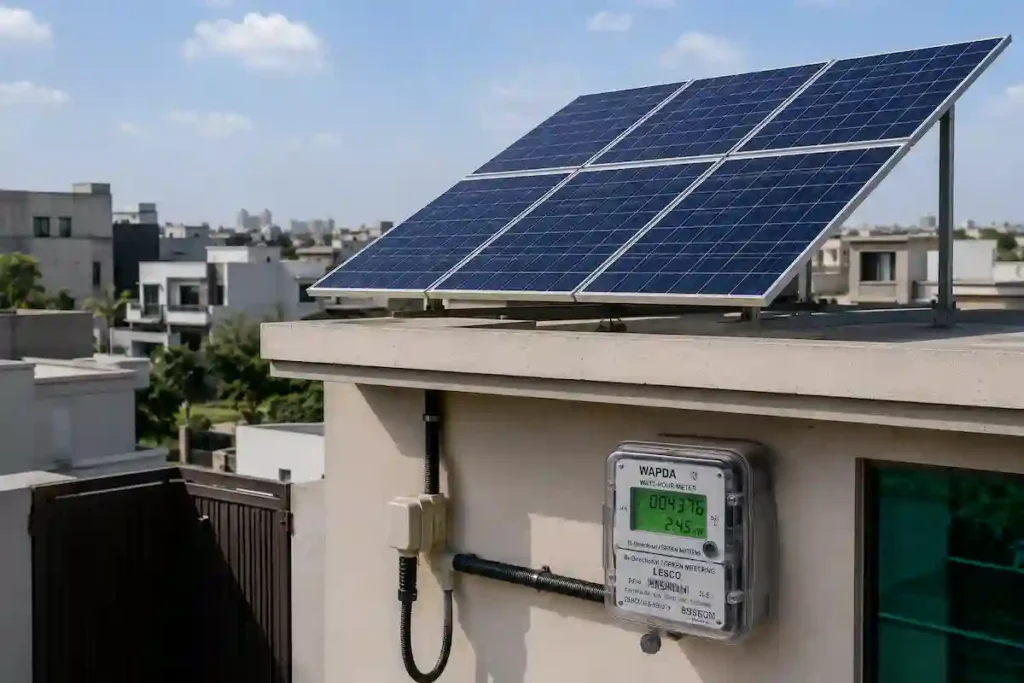
Most of the systems currently being installed in Pakistani cities are of this kind. The process is like this: The solar panels in your home produce electricity during the day, you use the amount that you need, and if there is any surplus, it is sent back to the WAPDA/LESCO/FESCO grid. By doing so, you earn credits for your surplus through net metering.
At night or on cloudy days, you simply draw power from the grid as usual.
What’s the catch? The problem is that if the grid fails, your on-grid system will also go off. It is an automatic shutdown feature designed to ensure the safety of DISCO linemen who might be working on the lines. So during load shedding, your beautiful solar panels will be there idling.
Who is it for? Those who experience very little load shedding (03 hours/day) and want to reduce their electricity bills and benefit from net metering.
Cost estimate: Rs. 150,000-200,000 per kW installed, no battery needed.
Off-Grid Solar
It is a system that has no dependence on the electricity grid.
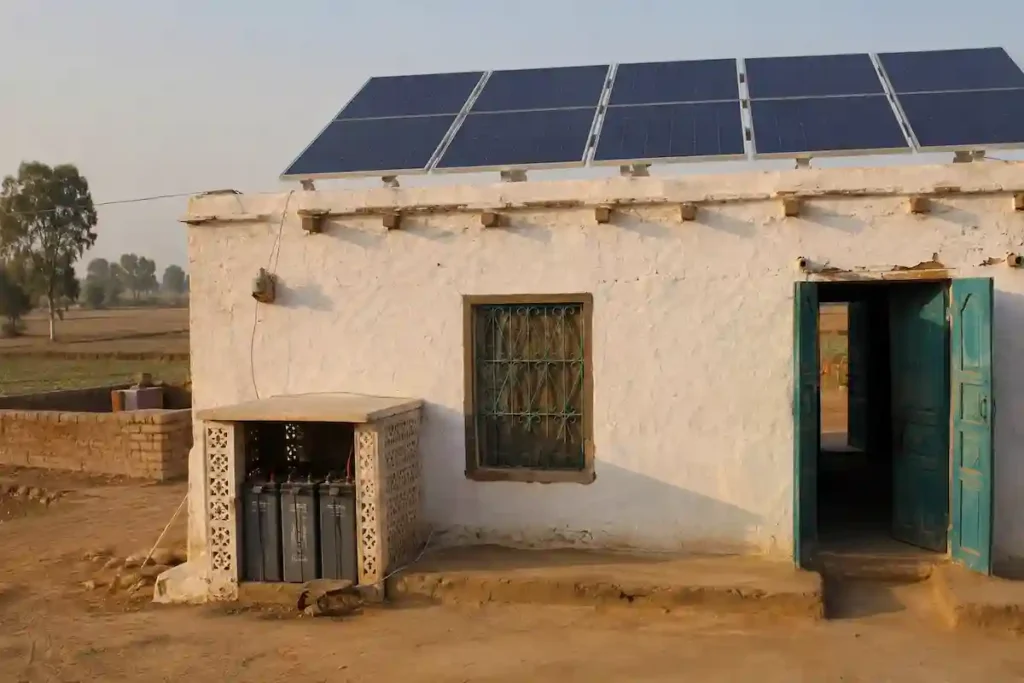
The technology is simply that your solar panels charge a battery set, and you operate your whole home off the stored power. One can say that it is their personal power plant. Typically, you would come across such a system in remote villages, agricultural farms, or places where the electricity grid is either totally unreliable or non-existent.
The honest downside: The truth is that you have to pay a high price for batteries. Also, they wear out. An adequate off-grid system with sufficient battery backup to keep an average house going through the night can be much costlier than an on-grid one. Besides, you must be careful about the appliances you use. High-power-consuming ones like geysers or air conditioners will rapidly deplete your batteries.
Who it’s for: People having no grid access or experiencing 12-20+ hours of load shedding, where connecting to the grid does not make any sense.
Cost estimate: Very high because of battery cost. Usually Rs. 300,000-600,000+ according to load requirements.
Hybrid Solar
This is one of the best options to combine. Actually, for many Pakistani families, this should be the beginning of the solar energy discussion.
A hybrid solution is connected to the grid as well as to a battery storage system. During sunlight hours, your solar panels provide electricity for your house. Other than that, the solar energy is helping to charge the batteries. If the batteries have reached the maximum capacity, then the energy is sent to the grid (net metering rules are valid). When load shedding occurs, you can go to battery power without any interruption. At night, the energy consumption is from the batteries first, and then, if necessary, from the grid.
The drawback: Batteries increase the initial investment. Also, the higher the duration of backups, the more batteries will be required.
Audience: Individuals residing in urban and semi-urban areas with at least 38 hours of daily load shedding who are interested in both savings and backup.
Estimated price: Rs. 200,000-350,000+ per kW according to battery capacity.
Also, for those who are interested, there is a very comprehensive solar system cost guide available that breaks down the costs of 3kW to 20kW configurations.
The Real-World Comparison: DHA Lahore vs. a Village Near Multan
I will illustrate this for you.
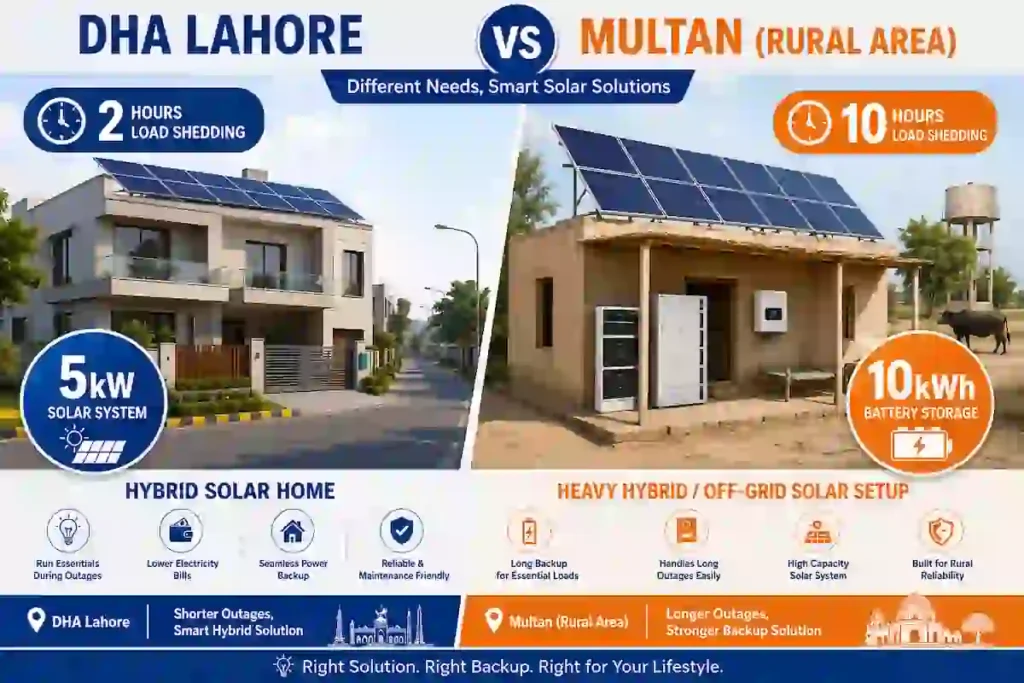
Case 1: DHA Lahore, 2 hours of load shedding daily
Living in DHA, Gulberg, or anywhere else with a more normal supply, your electricity supply is not interrupted often, your LESCO connection is reliable, but your electricity bills are probably high. In particular, if you have multiple air conditioners running in the summer.
My suggestion would be a hybrid system with a limited battery capacity, possibly 5 kW solar power with a 510 kWh battery. Your lives will not be interrupted by load shedding, your bill will be a lot lower, and you will also get the benefits of net metering for extra solar production.
Being entirely off-grid would be too much here. You would end up spending a lot of money on batteries that would remain underutilized.
Before making a final decision on the system size, it’s a good idea to run your appliances through JBMS’s free solar load calculator it only takes 2 minutes and gives you a much more accurate picture than any rough estimate.
Case 2: Village near Multan, 8-12 hours of load shedding daily
Such a situation is entirely different. Normally, net metering would be a very attractive offer, but if you are off the grid for about 8-12 hours, then obviously, the grid dependency is not your problem anymore.
In my opinion, a well-equipped hybrid system or off-grid solution with a significant battery capacity of at least 10 kWh is needed here. Your house must be able to work independently for the entire day. Every time.
Of course, it is a bigger investment initially. Still, when you consider that a 12-hour blackout day causes so much dissatisfaction, your working hours are lost, you cannot store food, you can’t use the water pump, your children can’t study, it makes a strong case for change.
Net Metering: Who Actually Qualifies?
Net metering in Pakistan is accessible mainly for on-grid and hybrid solar systems. The process involves you contacting your local DISCO (such as LESCO, FESCO, HESCO, etc.), having a bi-directional meter installed at your place, and then starting to accumulate credits whenever your solar panels generate excess electricity.
Here are some little-known facts that you are not told beforehand:
- It doesn’t happen overnight. It can take months for the whole process to be completed. So, you should not expect to see changes in your electricity bill right away.
- There must be a sanctioned load. Your electricity connection should be properly registered and legal.
- Off-grid solar systems are not eligible for net metering. It is because net metering takes a grid connection.
- The capacity of your system will play a role. DISCOs usually allow residential users to install facilities of up to 1 MW. But, in reality, 510 kW is the size range that fits most homes, and is considered the sweet spot.
If you are located in an area where the power supply is quite consistent, then net metering is highly beneficial. A few homes in Lahore, for example, can run their household with zero electricity bills, or in some cases, they even have small allowances. Yet, it is not that simple; it really hinges on the details of your consumption and generation and whether or not your solar system has been properly sized.
It would be great if, before making an application, you could check the NEPRA net metering regulation for 10 minutes. They update distributed generation rules, approve equipment lists, and publish the standard application form, all in one place. I’ve observed people’s interaction with their DISCO, resulting in unnecessary wastage of time due to the submission of old documents. If you download the current version directly from NEPRA, you’ll be able to prevent this problem. Also, in case your DISCO is not shown, you should call their local net metering unit first. The majority of them process applications manually, even before the online system.
Common Mistakes People Make
1. Buying on-grid in a high-load-shedding area.
What my neighbour did. On-grid looks cheaper, so people jump at it. Then they’re furious when it doesn’t work during outages.
2. Not having a large enough battery bank.
“I’ll just get a small battery to start.” Then the battery dies after 2 hours, and you’re back to suffering. If you’re going hybrid, size the batteries to cover your actual outage window, not a best-case estimate.
3. Getting a low-quality inverter.
Cheapest inverters break down. In fact, they break pretty often. Since the inverter is the brain of your system, you should not try to save money here. Brands like Fronius, SMA, Growatt, and Solis Inverters are generally reliable. Still, the cheap, generic Chinese ones, although they may save you Rs. 20,000 upfront. They would cost you Rs. 60,000 in repairs later.
4. Buying a system without getting the net metering set up first.
Some providers will not assist you with the DISCO process. So, whoever you choose to buy from should be the one either processing your net metering application or, at least, showing you the way.
5. Putting too much trust into a single installer’s recommendation.
Get three quotes. Ask each one to explain why they’re recommending that specific system configuration. If someone can’t explain it clearly, that’s a red flag.
Which System Should You Choose?
Here is a very basic guide:
- Less than 3 hours daily power outage, a good grid supply, and high electricity bills: On-grid with net metering
- Power cutting between 3 and 8 hours/day, wanting a backup, and having a moderate budget: Hybrid
- Uninterrupted load shedding for more than 8 hours or no reliable grid access: Off-grid or a very heavy hybrid
- Rural/agricultural use without any grid: Off-grid, no question
The solar sector in Pakistan is really going through a boom at this time, which means that it is possible to get great deals, as well as many fly-by-night solar installers. So, be patient. Ask the simplest questions. The correct solar system will be a good investment for 20-25 years. A wrong one will keep you on the edge of your seat for nearly as long.
Don’t be the one making your neighbour’s mistakes.